
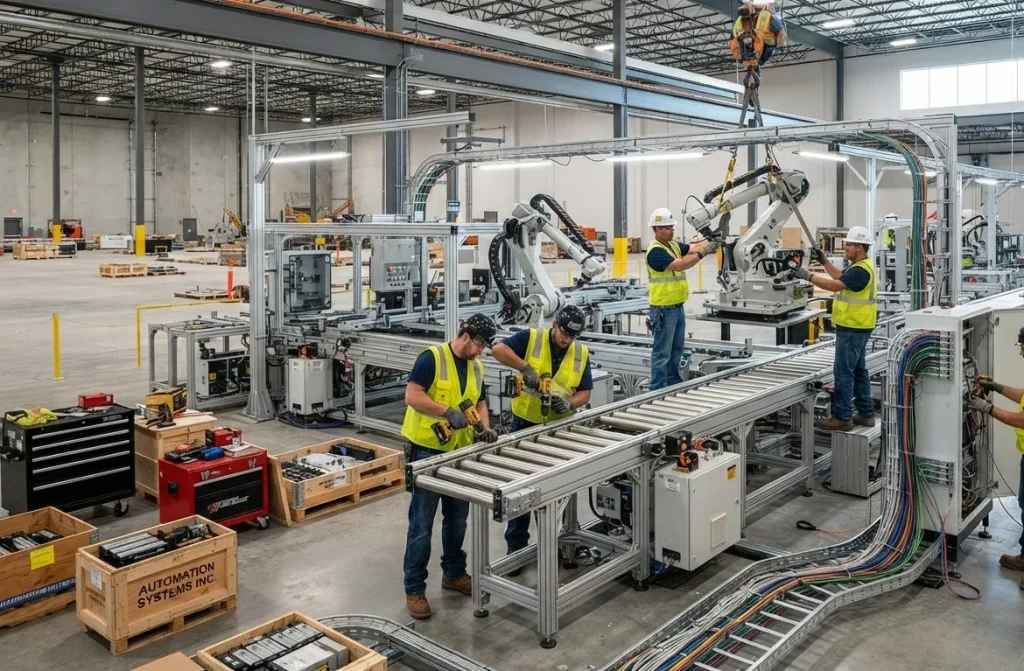
Reds Engineering explains industrial machinery alignment after relocation for Melbourne manufacturers, including mounting, positioning, and restart checks.
Relocating industrial equipment can change its position, level, mounting condition and relationship with connected machinery. Industrial machinery alignment should therefore be checked before the equipment returns to production, even when it operated correctly before the move. A defined installation and recommissioning scope help manufacturers identify mechanical issues early, coordinate responsible trades and avoid restarting equipment on an unsuitable foundation.
Why Must Machinery Be Realigned After Relocation?
Machinery must be realigned because lifting, transport, reassembly and placement on a different support can alter its operating geometry. Reusing old shim positions or matching previous floor marks does not demonstrate that the relocated machine is level, stable or correctly positioned. Changes to surrounding access or maintenance clearances can also make the previous position unsuitable, even if the machine itself remains undamaged.
The checks depend on the equipment and its place within the wider production-line installation. They may cover level and elevation, positioning against an approved datum, soft foot at the mounting points, coupled shafts, pulleys, rails or several machines operating as one line. Manufacturer instructions and project-specific tolerances should control the work because one generic tolerance is not appropriate for every machine, speed, coupling or drive arrangement.
What Should Be Checked Before Final Alignment?
Effective industrial machinery alignment begins with the foundation and mounting condition, not the measuring instrument. Before making fine adjustments, we need to establish that transport has not damaged or shifted components and that the destination is ready for installation.
- Project information: Review OEM instructions, installation drawings, datum points, equipment weights, lifting information and specified tolerances.
- Mounting condition: Inspect the foundation, baseplate, machine feet, shims, anchors and mounting faces for damage, contamination, distortion or uneven contact.
- Final placement: Confirm the position, orientation, level and clearance required for operation, cleaning, inspection, adjustment and future maintenance.
- Mechanical alignment: Check for soft foot before completing shaft, coupling or pulley alignment and tightening the hold-down bolts in the required sequence.
- Connected systems: Connect pipework, ducting and mechanical interfaces without imposing unintended force, then recheck machine position after those connections are finalised.
- Licensed work: Keep electrical disconnection, installation and reconnection within the scope of appropriately licensed electrical personnel and the agreed project responsibilities.
Verification Before Machinery Returns to Production
Final readings should be recorded after mounting fasteners are tightened and connected services are in their operating positions. Guards, lubrication points, anchors, emergency stops and other safety controls must also be inspected before authorised testing begins. WorkSafe Victoria’s plant safety guidance requires employers to consider hazards during installation, commissioning, operation and maintenance.
Commissioning may include controlled no-load and operating tests when those activities fall within the authorised scope and competent personnel are available. Excessive vibration, unusual heat or noise should be investigated rather than treated as proof of one fault, since looseness, imbalance, worn components and misalignment can produce similar symptoms. Final handover records should identify completed checks, measured results, approved changes, unresolved defects and the party responsible for each remaining action.
Reds Engineering and Industrial Machinery Alignment
A successful relocation finishes with verified positioning, documented measurements and controlled recommissioning, not simply with the machine bolted down. At Reds Engineering, we provide machinery assembly, installation, maintenance and repair through our fitters and turners, with each requirement confirmed against the equipment, site conditions and authorised scope. Supplying drawings, machinery details, destination information and required handover criteria help us define the mechanical work, specialist interfaces and quotation boundaries before site activity begins.
Request a scope-based installation assessment with your equipment specifications, drawings, relocation requirements and required production restart date.